The House We Live In
Broadway Celebrates America at 250 · Notes on the Music
Asheville Senior Chorus
Chuck Taft, Director · Eric Fricke, Piano
Sunday, October 25, 2026, 3 PM
Reuter Center, UNC Asheville
America turns 250 this fall, and Broadway has been throwing the party for more than a century. These notes are for the singers who’ll bring this program to life, and for anyone curious about where the songs came from. Every one of them has a story. Some of the stories are funny, a few are heartbreaking, and at least two involve Irving Berlin putting something in a drawer.
The program runs in seven chapters, like a parade moving through town. Twice, the parade stops. Then it picks back up and marches home.
I. Strike Up the Parade
Seventy-Six Trombones
The Music Man (1957) · Meredith Willson · arr. Ed Lojeski
Meredith Willson grew up in Mason City, Iowa, and played flute in John Philip Sousa’s band as a young man. He knew what a parade sounded like from inside it. When he finally got his Iowa musical to Broadway in December 1957, Robert Preston played “Professor” Harold Hill, a traveling con man who sells band instruments to small towns and leaves before anyone finds out he can’t read music.
“Seventy-Six Trombones” is Hill’s sales pitch. He describes a parade so vividly that River City forgets to doubt him. Willson hid a joke in the score: slow the same melody down to a waltz and it becomes Marian the librarian’s tender “Goodnight, My Someone.” The salesman and the librarian are singing the same tune without knowing it. The Music Man won the Tony for Best Musical that year, beating West Side Story.
A Cohan Salute!
Songs from the Cohan revues, 1904–1908 · George M. Cohan · arr. Don Besig
George M. Cohan swore he was born on the Fourth of July, 1878. His baptismal record says July 3. He went with the Fourth, and who could blame him. Raised on the vaudeville circuit as one of The Four Cohans, he was writing, composing, directing, producing, and starring in his own Broadway shows by his mid-twenties.
This medley gathers five of them: “Give My Regards to Broadway” and “Yankee Doodle Dandy” from Little Johnny Jones (1904), “Mary’s a Grand Old Name” from Forty-Five Minutes from Broadway (1906), “Harrigan” from Fifty Miles from Boston (1908), and “You’re a Grand Old Flag” from George Washington, Jr. (1906). That last one was originally “You’re a Grand Old Rag,” a phrase Cohan said he’d heard from a Civil War veteran. Veterans’ groups objected. Cohan changed one word and kept the fortune. In 1936 Congress awarded him a gold medal, the first ever given to a Broadway songwriter, and his statue still stands in Times Square.
II. Independence
Hamilton Highlights
Hamilton (2015) · Lin-Manuel Miranda · arr. Lisa DeSpain
Lin-Manuel Miranda took Ron Chernow’s 800-page biography of Alexander Hamilton on a beach vacation and came home hearing hip-hop. He performed the opening number at the White House in 2009, the show opened at the Public Theater in February 2015, moved to Broadway that August, and won 11 Tony Awards and the Pulitzer Prize. Its boldest idea, casting actors of color as the founders, is also its argument: this story belongs to everyone who lives in the country it made.
Lisa DeSpain’s medley packs seven songs into about five minutes: “My Shot,” “Who Lives, Who Dies, Who Tells Your Story,” “Alexander Hamilton,” “You’ll Be Back,” “The Schuyler Sisters,” “Wait for It,” and “The Room Where It Happens.” Yes, there’s rap. We’ll be fine.
The Egg
1776 (1969) · Sherman Edwards
1776 opened in March 1969 and won the Tony for Best Musical. Sherman Edwards, a former history teacher turned pop songwriter, set it in the Second Continental Congress in the sweltering summer of 1776, with John Adams (“obnoxious and disliked”), a sly Benjamin Franklin, and a Thomas Jefferson who’d rather be home with his wife.
“The Egg” comes near the end. The Declaration is written and the vote is close. Adams, Franklin, and Jefferson argue over the national bird: Jefferson wants the dove, Franklin the turkey, Adams the eagle. The metaphor is an egg about to hatch. Franklin really did prefer the turkey. In a 1784 letter to his daughter he called the eagle “a bird of bad moral character.” He wasn’t entirely joking.
Momma, Look Sharp
1776 (1969) · Sherman Edwards
The parade stops here for the first time. Late in the first act, a young Courier who’s been carrying dispatches from General Washington is left alone in the chamber with the custodian and a workman. Asked if he’s seen fighting, he sings about a soldier dying on the green at Lexington, calling for his mother, who searches the field for him when it’s over. It’s the one moment in 1776 that leaves the room and shows what all the arguing is costing. Edwards wrote it as a plain folk ballad, almost a lullaby. That’s why it lands so hard.
III. The Promise
Give Me Your Tired, Your Poor
Miss Liberty (1949) · Irving Berlin, words by Emma Lazarus · arr. Roy Ringwald
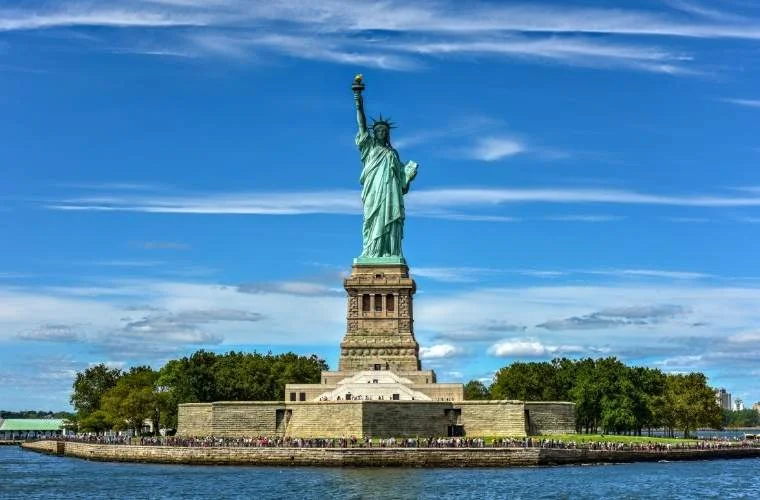
Emma Lazarus wrote her sonnet “The New Colossus” in 1883 to raise money for the Statue of Liberty’s pedestal.
She never saw the words on the statue; the bronze plaque went up in 1903, 16 years after her death. Irving Berlin, who had come through Ellis Island himself as a 5-year-old in 1893, set the last five lines of the poem as the finale of his 1949 musical Miss Liberty. The show was a modest disappointment. The song outlived it by a mile.
Roy Ringwald was Fred Waring’s chief arranger for decades, and his settings are the sound of American community choirs from the 1940s through the 1970s: rich, singable, built like hymns. This one rises slowly to “I lift my lamp.”
Ol’ Man River
Show Boat (1927) · Jerome Kern & Oscar Hammerstein II · arr. Hawley Ades
Show Boat opened December 27, 1927 and is usually called the first modern American musical: a serious story, spanning decades, with songs that move it forward instead of interrupting it. “Ol’ Man River” belongs to Joe, a Black dockworker on the Mississippi, and it’s the spine of the show, returning as the years pass.
Jules Bledsoe sang it first on Broadway. Paul Robeson, for whom the part was written, sang it in London in 1928 and in the 1936 film, and then kept singing it for 40 years, changing the words as he went. “I’m tired of livin’ and scared of dyin'” became “I must keep fightin’ until I’m dyin’.” A song about enduring became a song about resisting.
Make Them Hear You
Ragtime (1998) · Stephen Flaherty & Lynn Ahrens · arr. Jeff Funk
Ragtime, adapted from E. L. Doctorow’s novel, opened in January 1998 and braids three families through the first years of the 20th century: one white and suburban, one Black and from Harlem, one Jewish and just off the boat. Coalhouse Walker Jr. is a ragtime pianist whose car is destroyed by a racist fire company. The law fails him. His fiancée is killed. He takes the Morgan Library hostage.
“Make Them Hear You” is his last instruction to his followers before he surrenders: don’t avenge me, tell the story. Brian Stokes Mitchell sang it on Broadway and it became his signature. Jeff Funk’s arrangement was made from the original Broadway score.
IV. Postcards from Home
Oklahoma! Medley
Oklahoma! (1943) · Rodgers & Hammerstein · arr. Clay Warnick
March 31, 1943. The first Rodgers and Hammerstein show opened with no chorus girls, no overture worth mentioning, just a cowboy offstage singing about corn. It ran five years and 2,212 performances and changed what a musical could be. Set in Indian Territory in 1906, the year before statehood, it has a box social, a dream ballet, and a farmer and a cowman who really ought to be friends.
Ballgame
“Take Me Out to the Ball Game” (1908) · Albert Von Tilzer & Jack Norworth · arr. Debra Morton
Jack Norworth, a vaudeville performer, wrote the words on a subway ride in 1908 after spotting an advertisement for a game at the Polo Grounds. Albert Von Tilzer wrote the tune. By most accounts, neither man had ever been to a major-league game. Norworth reportedly attended his first in 1940. The verses nobody sings are about a baseball-mad young woman named Katie Casey who’d rather go to the ballpark than the theater. Our men will handle this one.
There Is Nothin’ Like a Dame
South Pacific (1949) · Rodgers & Hammerstein
South Pacific opened in April 1949 with Mary Martin and Ezio Pinza, won the Pulitzer, and swept the Tonys. Adapted from James Michener’s wartime stories, it’s about two love affairs and the prejudice that nearly wrecks both. This number belongs to the Seabees: restless sailors stuck on an island with no women, led by the scheming Luther Billis, griping in close harmony. It was written for an audience that had just come home from the Pacific.
A Wonderful Guy
South Pacific (1949) · Rodgers & Hammerstein · arr. Mark Brymer
The women answer. Nellie Forbush, a Navy nurse from Little Rock, has been trying not to fall for the French planter Emile de Becque. She fails, and this waltz is the sound of her giving up gladly. The story goes (Mary Martin told it herself) that she sang it with such abandon at one rehearsal that she fell off the piano bench, and Richard Rodgers told her that was exactly how he wanted it.
Fifty Nifty United States
Perry Como’s Kraft Music Hall (1961) · Ray Charles
Not that Ray Charles. This one was born Charles Raymond Offenberg in Chicago, led the Ray Charles Singers, ran the music on Perry Como’s television show for years, wrote “Letters, We Get Letters,” sang the theme to Three’s Company, and spent three decades as a consultant to the Kennedy Center Honors.
On November 1, 1961, Como’s show launched a state-of-the-week feature with a 47-second theme song. That first version didn’t even list the states. Charles added the alphabetical roll call when a publisher asked to print it, and the longer version slowly became the thing every American fourth-grader learns. Como’s feature only made it through 25 states before the show ended. Charles said he didn’t find out until about 1998 that schools were singing it. All 50 states in under three minutes, and yes, we’ll be memorizing them.
V. In Uniform
Oh! How I Hate to Get Up in the Morning
Yip! Yip! Yaphank (1918) · Irving Berlin
Irving Berlin was drafted in 1918 at age 30 and sent to Camp Upton at Yaphank, Long Island. He hated reveille. He talked his commanding officer into letting him write an all-soldier revue to raise money for the camp, and Yip! Yip! Yaphank played Broadway that August and September with a cast of some 300 servicemen. Sergeant Berlin sang this song himself, in uniform, dragged out of a tent by his bunkmates. He was not a good singer. That was the joke. He did the same bit again 24 years later in This Is the Army.
He wrote another song for that 1918 show and cut it. He thought it was too solemn for a soldier revue. Hold that thought until the end of the concert.
Tell My Father
The Civil War (1999) · Frank Wildhorn & Jack Murphy · arr. Andrea Ramsey
The parade stops a second time. Frank Wildhorn’s The Civil War opened at the St. James Theatre in April 1999. It has no plot, just voices from both sides, from enslaved people, from the home front, drawn from letters, diaries, and speeches of the period. “Tell My Father” is a young soldier’s dying message home: tell him I wore the blue, tell him I didn’t run, tell him I was brave.
Andrea Ramsey’s setting for men’s voices uses a solo violin as a second voice alongside the singers. It’s the companion piece to “Momma, Look Sharp,” another boy writing home, 85 years later.
VI. The House We Keep
Take Care of This House / My House
1600 Pennsylvania Avenue (1976) & Peter Pan (1950) · Leonard Bernstein · arr. Rob Fisher
In 1976, Leonard Bernstein and Alan Jay Lerner wrote a musical for America’s 200th birthday. 1600 Pennsylvania Avenue told a hundred years of White House history through the presidents and first ladies upstairs and three generations of a Black servant family downstairs. It opened May 4 and closed May 8, after 7 performances. Clive Barnes in the New York Times suggested waiting for the Tricentennial. Bernstein and Lerner withdrew the show entirely. No cast album was ever made. It was Bernstein’s last Broadway score.
One song survived. Abigail Adams sings “Take Care of This House” to a young servant boy as the Adamses move into the unfinished White House in 1800. Frederica von Stade sang it at Jimmy Carter’s inauguration the next January, with Bernstein conducting, and Julie Andrews, Marilyn Horne, and Kelli O’Hara have recorded it since.
“My House” comes from a different Bernstein project: the 1950 Broadway Peter Pan with Jean Arthur as Peter and Boris Karloff as Captain Hook. Wendy sings it to the Lost Boys as they build her a little house in Neverland. Rob Fisher, founding conductor of New York City Center’s Encores! series, set the two songs side by side for chorus, piano, and cello. A child’s house and a nation’s house. That pairing gave this concert its name.
The House I Live In
Let Freedom Sing (1942) · Earl Robinson & Lewis Allan
Let Freedom Sing was a small, earnest revue that opened October 5, 1942 and closed after 8 performances. That would have been the end of this song, except that in 1945 RKO made a 10-minute film in which Frank Sinatra breaks up a gang of boys chasing a Jewish kid, tells them one American’s blood is as good as another’s, and sings it. The film won an honorary Academy Award and sits on the National Film Registry. Sinatra sang the song for the rest of his life.
The writers paid for their politics. Composer Earl Robinson was blacklisted in the 1950s. The lyricist, who published as Lewis Allan, was Abel Meeropol, a Bronx high-school English teacher who had already written “Strange Fruit” for Billie Holiday. He and his wife later adopted the two orphaned sons of Julius and Ethel Rosenberg. Same man, same question: who counts as an American? His answer was “all races and religions, that’s America to me.”
VII. The Parade Goes On
God Bless America (Festival Edition)
Written 1918, revised 1938 · Irving Berlin · arr. Roy Ringwald
Here’s the song from the drawer. Berlin wrote it at Camp Upton in 1918 for Yip! Yip! Yaphank and cut it before opening. Twenty years later, with war coming again in Europe, Kate Smith’s manager asked him for something patriotic for her Armistice Day broadcast. Berlin dug it out, revised a few lines, and Smith sang it on the radio on November 10, 1938. He signed over every penny of royalties, forever, to a trust benefiting the Boy Scouts and Girl Scouts of America.
Roy Ringwald’s Festival Edition ends with a verse built for the audience to stand and sing. They will. So will we.
Bring a friend, bring a flag, bring your voice. Sunday, October 25, 2026, 3 PM
Reuter Center, UNC Asheville. Admission is free.

The Asheville Senior Chorus is an active chorus as part of the Community Partnership Program with the Osher Lifelong Learning Institute (OLLI) at UNC-Asheville. Led by Chuck Taft, they produce harmonious tunes while also building strong bonds and valuing shared moments. Their concerts feature a diverse range of musical styles and periods.
QUICK LINKS
GET IN TOUCH
- PO Box 8185 Asheville, NC 28814
- info@ashevilleseniorchorus.com
- +1 828 633 1813
©2026 Asheville Senior Chorus. All Rights Reserved.