
The Science of Singing: How Choral Music Protects Your Brain as You Age
What if one of the most powerful tools for protecting your brain as you age wasn’t a pill, a puzzle, or a gym membership – but a song?
Memory: The Most Powerful Benefit
Of all the cognitive benefits linked to choral singing, memory improvement stands out most clearly in the research.
A landmark 2025 neuroimaging study examined the impact of choral singing on episodic memory – the type of memory most vulnerable to aging. Using fMRI brain scans, researchers found that regular choir participation significantly improved episodic memory and positively influenced related brain networks in older adults. Critically, the improvements scaled with rehearsal attendance – the more consistently participants sang, the greater their memory gains.
The study also found increased functional connectivity between the right lateral prefrontal cortex, left posterior fusiform cortex, and left hippocampus – the precise regions most affected by age-related memory decline. In plain language: choir singers were building stronger neural connections in the exact areas where aging does the most damage.
A separate 2025 study of 95 adults aged 21 to 88 confirmed that lifetime duration of choir singing was directly associated with enhanced episodic memory and verbal fluency – benefits that persisted across the entire adult lifespan.
Singing Fights Depression and Improves Quality of Life
The mental health benefits of choral singing are equally compelling. Research consistently shows that regular choir participation reduces depressive symptoms – and that this reduction in depression directly improves overall quality of life.
This matters enormously because depression is recognized as a significant risk factor for dementia. By reducing depression, choral singing may be addressing one of the most critical pathways through which cognitive decline accelerates.
A two-year longitudinal study tracking 107 choir singers and 62 non-singers found that choir singers maintained sustained enhancement in verbal fluency over time, while also reporting stronger social engagement and higher quality of life scores.
White Matter, Connectivity, and Structural Brain Health
Beyond cognitive performance, choral singing appears to physically strengthen the brain’s architecture.
Research shows that amateur choir singing is strongly associated with enhanced white matter microstructure – the neural “wiring” that connects different brain regions. For older adults specifically, choir singing was linked to improvements in the fornix, a key white matter tract critical for memory and limbic system function.
These structural changes suggest that singing doesn’t just improve how the brain performs – it may actually slow the physical deterioration of brain tissue that comes with aging.
The Choir Advantage: Why Group Singing Amplifies the Benefits
Individual singing offers benefits, but choral singing appears to multiply them. The reason is simple: choir singing adds layers of cognitive demand that solo singing cannot replicate.
When you sing in a choir, you must simultaneously:
- Read and memorize music
- Listen to your own voice and adjust pitch
- Listen to the voices around you and blend
- Follow a conductor’s direction
- Stay in rhythm with the ensemble
- Process lyrics and their emotional meaning
This multitasking demands – and therefore strengthens – executive function, attention, processing speed, and working memory all at once. Add the social connection of rehearsing and performing with others, and you have what researchers describe as “a particularly promising tool for promoting cognitive reserve” in aging adults.
At the Asheville Senior Chorus, the Science Comes Alive
For the members of the Asheville Senior Chorus, these findings aren’t abstract – they’re lived experience.
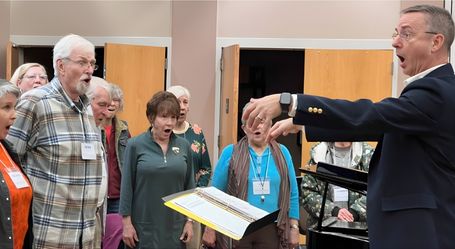
Under the direction of Music Director and Conductor Chuck Taft, with accompanist Eric Fricke, over 50 singers gather every Monday evening as part of the Osher Lifelong Learning Institute (OLLI) at UNC Asheville. They learn complex choral arrangements, perform concerts for their community, and build the kinds of deep friendships that research links directly to cognitive resilience.
And here’s the best part: no auditions required. The Asheville Senior Chorus asks only one thing of its members – a love of singing.
“This choir changed my life,” one longtime member shared. “I’ve made incredible friends and discovered I could sing.”
That joy, that connection, that weekly commitment to making something beautiful together – it turns out, it’s also protecting their brains.

The Bottom Line
The science is clear and growing: choral singing is one of the most powerful, enjoyable, and accessible tools available for protecting brain health as you age. It builds memory, fights depression, strengthens neural connectivity, and creates the social bonds that research consistently links to longer, healthier lives.
You don’t need to be a trained singer. You don’t need to read music. You just need to show up and sing.
Ready to Protect Your Brain Through Song?
The Asheville Senior Chorus welcomes new members for the 2026 season. No auditions. No experience required. Just bring your voice and your love of music.
Rehearsals: Every Monday, 6:15 – 8:15 p.m.
Location: Mannheimer Room, Reuter Center, UNCA Campus (300 Campus View Drive, Asheville, NC)
Contact: info@ashevilleseniorchorus.com | (828) 903-4272
Website: ashevilleseniorchorus.com
Your brain will thank you.
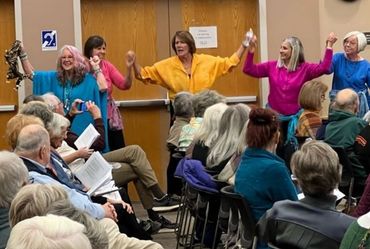
The Asheville Senior Chorus is an active Community Partner that meets every week as part of the Osher Lifelong Learning Institute (OLLI) at UNC-Asheville. Led by Chuck Taft, they produce harmonious tunes while also building strong bonds and valuing shared moments. Their concerts feature a diverse range of musical styles and periods.
QUICK LINKS
GET IN TOUCH
- PO Box 8185 Asheville, NC 28814
- info@ashevilleseniorchorus.com
- +1 828 903 4272
©2025. Asheville Senior Chorus. All Rights Reserved.